Phone: 626 963 4591
Monday – Friday
9am – 6pm PDT
Welcome to Harbor Models Inc.
Category - Pleasure Crafts
Yachts, river cruisers and Chris Craft models, 18 pleasure crafts to peruse.
 The hull is a fully detailed GRP molding. Superstructure and deck are CNC cut ply with printed ply overlays. Ships boats are styrene moldings. Bow and stern decorative scroll work, ships name, saloon windows and door furniture are etched brass. Over 800 fittings are cast from high quality white metal (with 34 for the anchor windlass alone). All wood dowel, rod, wire and cordage are supplied to make this a model to be proud of. Schaarhorn was built in 1908 and used as the Hamburg state Yacht, in 1973Schaarhorn was sold and brought to the U.K. In 1990 she was sold to a preservation society in Hamburg and fully restored. It is now used for pleasure cruises. The model was built using original drawings as well as photographs taken of the restored vessel. Scale: 1:35 Length: 44-7/8" (1140mm) Beam: 7-1/16" (180mm) $929.00 |
 Sea Queen is based on the lines of a typical early 60's ocean going cabin cruiser. The hull matched motor and prop give superb scale speed and handling characteristics on just 12V. Kit includes: All required timber CNC manufactured pre-cut and pre-profiled components All windows glazed and framed 6 glazed and framed portholes Integral engine mount Integral R/C platform Stainless steel prop shaft (M4) Coupling unit Hull matched 12V low drain, high torque, electric motor Hull matched 75mm, 3 bladed, cast solid brass prop (M4) Large brass rudder Searchlight 6 fairleads; Ships wheel 2 cleats, 1 red side light, 1 green side light, 1 two tone horn, 2 jackstaffs, anchor, comprehensive instruction manual and scale plan sheets. Specifications: Scale: Not Available Length: 46-1/16" (1170mm) Beam: 14-9/16" (370mm) $580.00 |
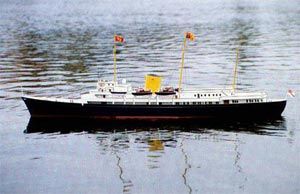 The origins of Britannia can be followed back to 1938 when it was agreed that the current yacht Victoria and Albet 111 was due for replacement. The Admiralty prepared a set of outline drawings for tender. The start of WW11 postponed the project until 1952 when the idea was revived and subsequently ordered from John Browns shipyard on the Clyde due to their expertise in constructing top class ships such as the Queens and the Coronia. The design specifications for the ship are impressive for she had to be capable of continuous operations in the Arctic and Tropical waters. She is capable of a continuous sea speed of 21 knots and has a range of 2,000 miles at full speed on a displacement of 4,715 tons. Two Steam turbines on each shaft provide a total of 12,000 h.p and in full speed burn 117 tons of fuel a day. Electrical power is provided by three 500 KW steam turbo generators and a single 270 KW diesel for harbor duties. The ships company comprises twenty one officers and 256 men and when on Royal duties a twenty six piece Royal Marine band. Within her design the utmost care has been taken in fine details, a few examples are, the funnel has been carefully shaped and fitted with internal filters plus the exhaust gas speed has been uprated to ensure that no soot falls on the decks. A flange is fitted around the top edge of the funnel to trap water and this is piped down inside to prevent the top of the funnel becoming stained. The funnel also acts as a derrick post for the two booms, To preserve the lines the eye plates hinge back into the casing when not in use and cover plates are fitted. Other fine points are the freeing ports/ bulwark doors are open at sea as required but can be closed when not in use to preserve the unbroken line of the bulwarks. The front of the bridge has been designed in a wind tunnel to prevent any strong wind eddies forming. Denny brown active fin stabilizers were a new feature at the time, the twin fins can reduce a roll of twenty degrees to six degrees at a speed of 17 knots. The ships engines are staggered at 10 r.p.m difference to help reduce vibrations Britannia, as can be expected is constructed to lloyds 100A1 standard following naval practice the platform deck is watertight throughout and the lower hull is divided by fifteen watertight bulkheads. To produce the immaculate finish on the hull the steel above the waterline is riveted but worked flush. Below the waterline the plate are lapped and the forward edges are faired with composition to reduce drag. The ship is designed to convert to a hospital ship in times of crisis, she can accommodate 200 patients within the spaces occupied by the Royal apartments. She was named and launched by Her Majesty The Queen on the 16th April 1953 as the previous ship of this name was King George V11s racing yacht which was scuttled on his death in 1936. The fate of Britannia at the present time is undecided although the Queen has expressed the wish that some future role be found for the ship rather than see her broken up. Specifications: Scale: 1/96 Length: 1.3m ( 51.2") Beam: 178mm (7") The model of Britannia is based on a fiber glass hull with bulwarks, portholes, proptube exits and bilge keels molded into the hull. The construction of the superstructure is from computer generated printed plastic in 1mm and .5m. To finish the assembly, vacuum formed pieces are provided for the funnel and all ships boats for those who wish to add lots of detail. Also included as an option are a complete set of the ships motor boat hulls with all detail molded into the castings to give two options for the model. To add the finishing touch, all fittings are included cast in light alloy or plastic. Brass etchings are supplied for the Ships stanchions and ladders. Prop tubes fitted with oiling tubes and stainless steel shafts are included together with a comprehensive instruction book to aid assembly with sketches and pictures to assist in the construction. All part numbers are keyed to the FULL SIZE PLAN included in the kit. Full details are supplied for the fitting of motors, nicads, and radio equipment. $1,099.00 |
 Said to be one of the finest pleasure craft ever built in New Zealand. She is the 65ft twin screw motor yacht, Dufresne, designed by Laurent Giles and partners of England for Mr Jack Butland of Auckland, and built by M.C. Carter Ltd. Laurent Giles is noted not only for the excellence of his designs, but also for the very distinctive character and good looks of his boats. Dunfresne is no exception, and the workmanship of her New Zealand builders matches the high standard of her design. Mr Butland and Mr Carter went to England to discuss both design and construction methods with Jack Giles in November, 1964, and found that they had not yet used glued construction to the extent that we have in the U.K. Max Carter took with him photos of some of the local boats built by the methods he wanted to use, and Mr Giles was most impressed with them and keen to see so much laminating used in the proposed boat. He was, however, a little taken aback at the idea of building such a large boat upside down. The hull design was left entirely up to Laurent Giles except for a suggestion that she could have more beam. This was increased by 18in at the deck but the bottom shape, which had been tank tested,and was not altered. Building started on May 19,1965 and she was launched on October 1, 1966. One of the first jobs and the biggest laminated member was the stem. Construction is unconventional, there are no floors in the boat other than at the main bulkheads. These are replaced by 2 3/4 x 3/4 ribs from gunwale to gunwale dinghy fashion, at varying centers according to positions but averaging about 2ft spacing. Ordinary spotted gum timbers were fitted at 7in centers with multiple light stringers of 2 3/4 by by 3/4, running force and aft. Planking is two diagonals of 1/4in, and one fore and after outer skin of 9/16in, all Epilogued and through fastened. It was estimated that in 1965, half a ton of nails and over �1000 worth of glue were used. The complete hull was sheathed in dynel before being turned over. The whole construction is unusually light for a boat of this size but undoubtedly very strong. Dufresne`s probable top speed is 15 knots at 3,000 rpm and 13 knots cruising speed at 2,500. The hull is of a round bilge high speed displacement type and an unusual feature is the knuckle built into the topsides for`ard. The fast displacement hull needs a fine entry and the knuckle allows this while still gaining plenty of reserve buoyancy very quickly. It also gives the effect of a big flare without excessive width on the decks, and makes the boat relatively steady and dry in a seaway. Mr Butland has named his boat after the famous Frenchman Marion du Fresne (pronounced du Frain), who came to N.Z. in 1772 in his ship Marquis de Castries, in company with Lieut. Crozet commanding the Mascarin. They spent several months in the Bay of Islands carrying out repairs and du Fresne was the first person to survey the area. He also attempted to claim New Zealand for France and called it France Australe, although he knew Captain Cook (1769) had already claimed it for Great Britain. History books record different versions of the events leading up to his violent death. Some say it was revenge for the cruelty of another Frenchman, others that Marion du Fresne and his crew were the friendly with the Maoris until they inadvertently desecrated some sacred tribal ground. However, it is a fact that du Fresne and about 20 of his crew were enticed ashore, killed and eaten in the Bay of Island. Specifications: Scale: 1/24 Length: (32-1/2" (825mm) Beam: 8" (203mm) Sailing weight 3.8kgs The Kit: The kit is based on a detailed fiber glass hull with rubbing strip, bulwark scroll work, prop tube and rudder exits, moulded into the hull. The Deck is from printed plywood with lining for engraved planking. Vacformings in styrene form the complete cabin assembly and ships boat. Printed plastic supplies the construction for the wheelhouse cockpit. A full set of fittings is included in the kit with prop shafts, rudders, prop and tillers arms, plus decals and details to complete the wheelhouse To aid construction a comprehensive instruction book and full size plan is included. Printed plastic supplies the construction for the wheelhouse cockpit. $585.00 |